


The Executive Committee Bio Page
 Prof Stephen Rice is the President of the British Society for Geomorphology Executive Committee. Steve is a fluvial geomorphologist interested in the interactions between physical fluvial processes and river ecosystems. A significant focus of his more recent work has been freshwater zoogeomorphology and ecosystem engineering, including experimental work with crayfish, freshwater fish and aquatic insect larvae. More broadly, Steve works on the sedimentary structures and size characteristics of gravelly, river-bed sediments including sediment sorting and water-worked structures, bar formation processes and the links between fluvial sediments, lotic ecology and river habitat at a range of spatial scales. Steve runs the BiG (BioGeomorphology) Lab at MMU, which is focused on understanding how biogeomorphological processes affect sediment fluxes, landscape change, habitat provision and ecosystem health; and the societal opportunities and hazards that follow.
Contact: s.rice@mmu.ac.uk
 Dr Chris Hackney is the Chair of the British Society for Geomorphology Executive Committee. Chris is a Senior Lecturer in Physical Geography in the School of Geography, Politics and Sociology at Newcastle University. He is a fluvial geomorphologist who researches sediment and water transport through river and delta systems, particularly in South East Asian deltas such as the Mekong, Red and Irrawaddy systems. He is interested in the way that humans are impacting natural fluvial processes, with a particular focus on sand mining, and how these impacts ultimately affect the populations and communities which make deltaic regions their home.
Contact: christopher.hackney@ncl.ac.uk
 Prof Ian Candy is the Senior Deputy Chair of the British Society for Geomorphology Executive Committee. Ian is a physical geographer interested in the response of the landscape to long- and short-term climate change. This research involves understanding the sediments and landforms left behind by rivers, lakes and aeolian processes, establishing their age and understanding how climate forcing has controlled their development. His research also involves producing high resolution climate records using oxygen and carbon isotopic analysis of lake sequences against which patterns of geomorphic change can be compared. Much of Ian’s work involves collaborating with archaeologists in order to understand the landscapes and environments of early humans and more recent societies from the earliest occupation of northern Europe through to the Little Ice Age.
Contact: Ian.Candy@rhul.ac.uk
 Dr Rob Bryant is the Junior Deputy Chair of the British Society for Geomorphology Executive Committee. Rob initially trained as an Earth Scientist, with a PhD at PRIS/Department of Geography, University of Reading investigating the “sedimentology and hydrochemistry of the Chott el Djerid, Tunisia using remote sensing” – this involved pioneering work with Landsat 5 TM, and allowed him to enter the world of Earth Observation. Post-PhD Rob worked as a Research Assistant at Reading working on the pre-processing of AVHRR data for the Amazon, and then spent a summer in Iceland monitoring aeolian processes. He then gained Postdoctoral Fellowship and Lectureship positions in Environmental Science at the University of Stirling where his research broadened into the use of airborne remote sensing and field spectroradiometry in fluvial and estuarine process domains. Rob then moved to a Lectureship in Applied Remote Sensing at Sheffield and has now been at Sheffield for over 25 years, and in that time have been promoted to Senior Lecturer and Reader in Earth Observation. Rob attended his first BSRG meeting in 1991 and first BGRG (BSG) Conference in 1999. His first ESP&L paper was published in 1995.
As an Earth Observation Scientist, with a geomorphology background, Rob is interested in Landscape Dynamics and Earth/Atmosphere interactions and is particularly interested in the global dust cycle – with emphasis on the impacts that geomorphological, hydrological and ecological processes have on dust fluxes and Sand & Dust Storms across the globe. His research in this area has included the first regional and continental scale mapping and characterisation of dust sources and emission using EO. In addition, Rob has championed and demonstrated the use of EO data (including near and far surface approaches) as applied to a range of dynamic land surface domains and biomes/ecotones (e.g. rivers, wetlands, coasts, tropical forests, and where they interact) as well as land/atmosphere fluxes from these (e.g. fire, flooding), and aspects of spatial ecology/Conservation (e.g. forest change and selective logging). Rob has undertaken fieldwork across the globe, and has received funding to support his research from ESA, UKRI, Royal Society, Leverhulme and other funding agencies. Rob has supervised or co-supervised 39 PhD students, and in 2021 received a CAS President’s Fellowship to investigate dust emissions in the Gonghe Basin, China. In 2025 Rob received an award from OSINFOR (the Peru Governments Forest Protection Agency) to recognise how he has used EO data to protect the Peruvian Amazon.
Contact: r.g.bryant@sheffield.ac.uk
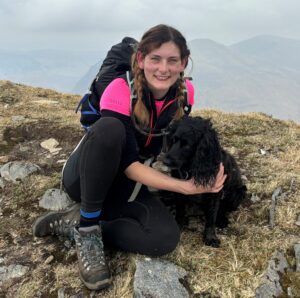 Dr Fiona Caithness is the Honorary Secretary of the British Society for Geomorphology Executive Committee. She works in the applied sector as a Senior Hydromorphologist at the Scottish Environment Protection Agency (SEPA). In this role, Fiona helps shape river management policies and provides geomorphological expertise to support the regulatory framework for river engineering works. She also contributes to delivering the Water Environment Fund’s restoration projects, which focus on improving river morphology and enhancing community engagement with the water environment. Her main research interests include role of in-channel wood, channel change, and restoration in gravel-bed rivers.
Contact: fiona.caithness@sepa.org.uk
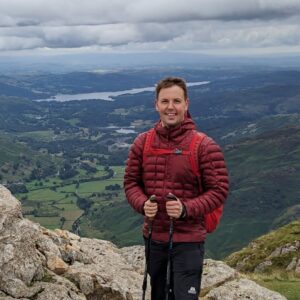 Dr Rich Boothroyd is the Honorary Treasurer of the British Society for Geomorphology Executive Committee. Rich is a Lecturer in Physical Geography at the University of Liverpool, specialising in fluvial geomorphology, remote sensing and geomorphic hazards. His research uses geospatial technologies and big data to understand geomorphic processes, including assessing the risks that shifting rivers pose to communities and infrastructure in dynamic landscapes.
Contact: richard.boothroyd@liverpool.ac.uk
 Dr Joshua Ahmed is the Membership Secretary of the British Society for Geomorphology Executive Committee. Josh is a process geomorphologist interested in the evolution of meandering rivers and their floodplains, more recently focusing on understanding mechanisms of contaminant dispersal across the landscape, using a combination of remote sensing and field-based surveying techniques, at Queen Mary University of London.
Contact: geomorphicjosh@gmail.com
 Dr Emma Shuttleworth is the Research vice-chair of the British Society for Geomorphology Executive Committee. Emma is a peatland scientist with a focus on how landscape management and restoration can improve the geomorphology and hydrology of degraded systems. In severely eroded peatlands, topography is highly variable, and an appreciation of geomorphological form and process is key in understanding the controls on peatland function, and in mitigating the negative impacts of peatland erosion. Her research investigates how upland peatlands can be best managed for flood risk reduction and climate resilience, and how these management and restoration practices may reduce sediment and legacy contaminant release. Other work focusses on catchment management more generally and the impacts of fire on sediment and contaminant dynamics. She works with a wide network of restoration practitioners to provide the evidence base for the impacts of restoration and drive evidence-led policy change.
Contact: emma.shuttleworth@manchester.ac.uk
 Dr Stuart Grieve is the Communications and Publications vice-chair of the British Society for Geomorphology Executive Committee. Stuart is a computational geomorphologist, specialising in the development and application of computational methods that integrate remote sensing, field data and numerical modelling to answer questions about the nature of planetary surface change.
Stuart’s current research covers three main themes: Planetary surface processes, focusing on the evolution of landforms on Mars; vegetation-landscape interactions, with a focus on how trees and their roots modulate sediment transport and landsliding; and the intersection of humans, the climate crisis and landscapes with the aim of understanding the erosion of contaminated land and the fate of eroded contaminants such as microplastics. He approaches these themes from a computational perspective, integrating his software engineering background into the scientific process to develop robust and reproducible scientific workflows. Away from academia his interests include cuesports, vegan junk food, and writing about himself in the third person.
Contact: s.grieve@qmul.ac.uk
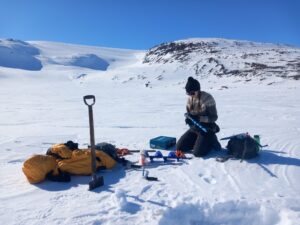 Dr Kathryn Adamson is the Outreach and Education vice-chair of the British Society for Geomorphology Executive Committee. Kathryn’s research examines the way that landscapes – particularly glaciers and rivers – respond to climate change over modern and Quaternary timescales. She uses a combination of geomorphology, sedimentology, geochemistry, and geochronology. Much of her recent work combines scientific analysis with local community knowledge and current projects are based in Greenland, Iceland, North America, Egypt, and the UK.
Contact: k.adamson@mmu.ac.uk
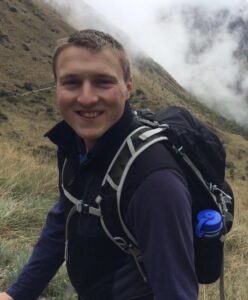 Matthew Hemsworth is the Professional Geomorphology vice-chair of the British Society for Geomorphology Executive Committee. Matthew is a Chartered Technical Director with over 17 years of specialist experience in fluvial geomorphology. He leads complex, multidisciplinary projects across consultancy, regulatory, and environmental restoration sectors, combining technical expertise with strategic leadership. As Deputy Head of Environment and Sustainability at JBA Consulting, Matthew has delivered innovative habitat and river restoration schemes across the UK, Europe, Asia, and Africa. His work integrates advanced geomorphological analysis, cutting-edge modelling, and GIS techniques to address challenges such as sediment dynamics, erosion risk, and the impacts of large-scale natural events. He has authored industry guidance and championed sustainable, catchment-scale solutions that enhance ecosystems and resilience.
Passionate about professional development, Matthew provides targeted training for regulatory bodies and mentors colleagues pursuing chartership. His commitment to knowledge sharing and raising professional standards reflects his active role in advancing geomorphology as a discipline.
Contact: matthew.hemsworth@jbaconsulting.com
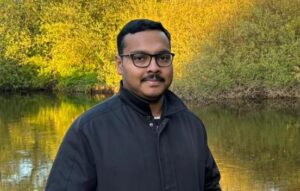 Jayesh Mukherjee is the PGR Committee vice-chair of the British Society for Geomorphology Executive Committee. Jayesh is an aspiring quaternary geomorphology researcher presently based at the Earth Surface Processes Research Group, Department of Geography and Earth Sciences, Aberystwyth University, Wales, UK as a PhD candidate. His doctoral research focuses on the quaternary fluvial evolution of the Luni River’s floodout zone (inland delta) in southern Rajasthan, adjoining the southeastern Thar Desert of India. He has obtained an MPhil specializing in dryland fluvial geomorphology from Jawaharlal Nehru University, New Delhi and holds a BSc (Honours) and MSc in Geography from Presidency University, Kolkata. Apart from these, Jayesh has completed a PG Certificate in Climate Change and a PG Diploma in Disaster Management from Indira Gandhi National Open University, New Delhi. He has recently attained an Associate Fellowship of the Higher Education Academy (AFHEA) from the Advance HE, UK.
Contact: jam169@aber.ac.uk